Div3DAfford: Diverse 3D Affordance Grounding
Purdue University
Abstract
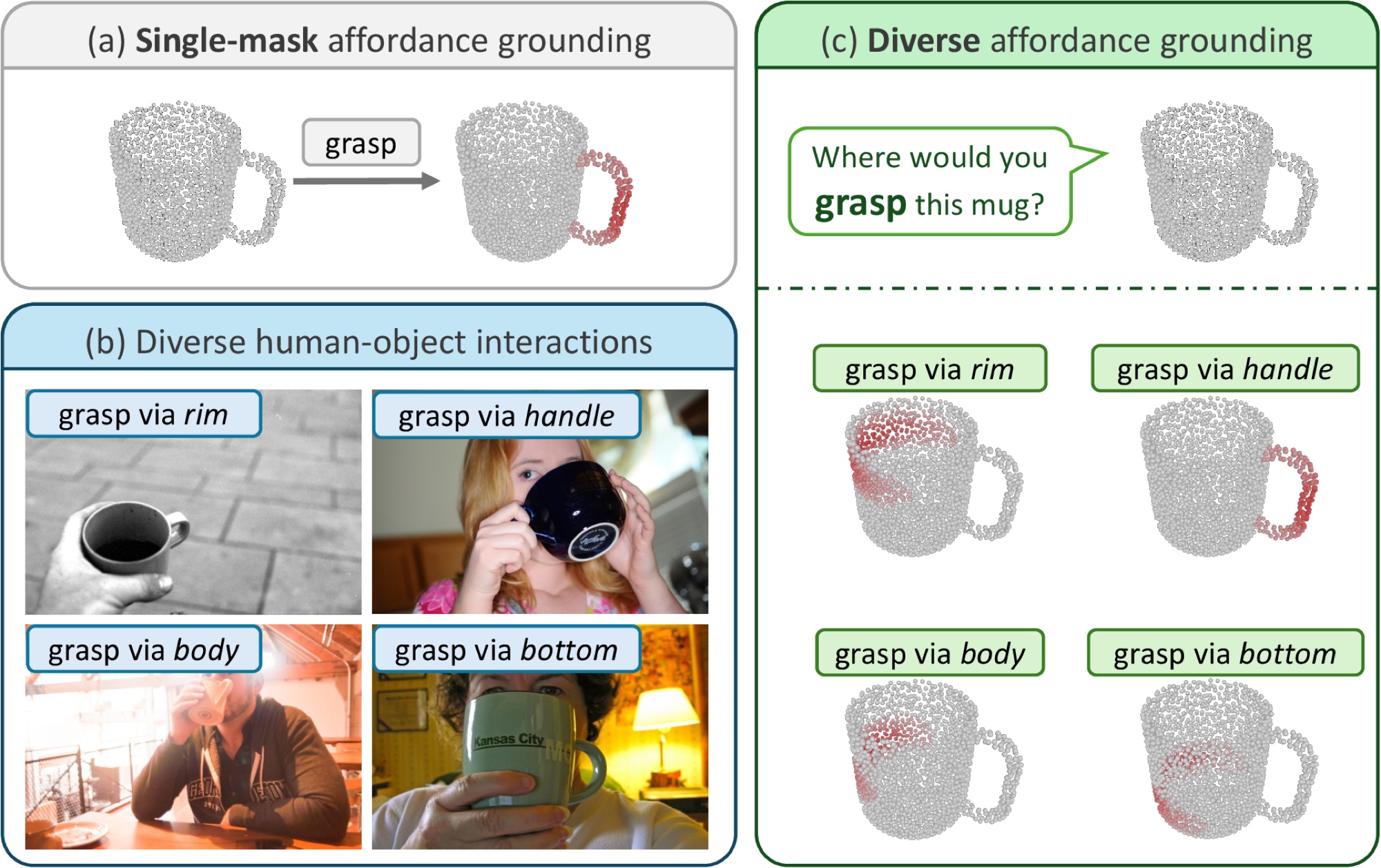
3D affordance grounding aims to localize 3D regions specified by an interaction query. Existing methods predict a single affordance mask, overlooking the inherent diversity of human-object interactions. We introduce diverse 3D affordance grounding, a new task that requires predicting multiple plausible regions for a given object and affordance query. We then propose Div3DAffordNet, a transformer-based set prediction model capable of generating diverse affordance regions. To address the scarcity of diverse 3D affordance data, we develop an automated pipeline leveraging 2D generative models and 3D reconstruction techniques to synthesize 3D affordances, followed by lightweight human verification (reducing the annotation time by 72×), yielding the Div3DAfford benchmark. Extensive experiments show Div3DAffordNet effectively captures multi-mask affordance regions. Our method achieves the SOTA affordance grounding performance in the multi-mask setting, reducing GED-SIM from 0.745 to 0.492, while maintaining competitive single-mask performance on the standard benchmark of 19.0 mIoU.
Div3DAffordNet
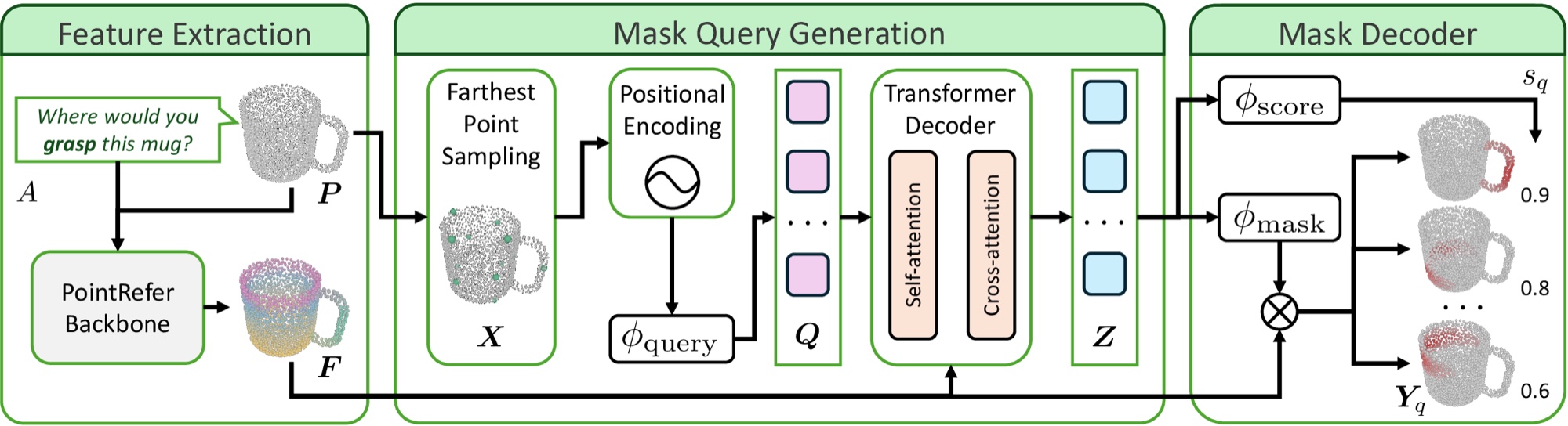
Inspired by DETR, we equip PointRefer with a query-based multi-mask decoder for variable-size set prediction. Given a point cloud $\mathbf{P}$ and an affordance query $A$, a PointRefer backbone extracts language-conditioned point-wise features $\mathbf{F}$. Mask queries are initialized from farthest-point-sampled 3D seeds, which encourages broad coverage of the object surface, and are refined with a transformer decoder. Each refined query predicts a validity score $s_q$ and a mask embedding, which is correlated with the shared point-wise features to produce a candidate affordance mask $\mathbf{Y}_q$. Masks with scores above a threshold are kept as the final diverse predictions.
Div3DAfford Benchmark
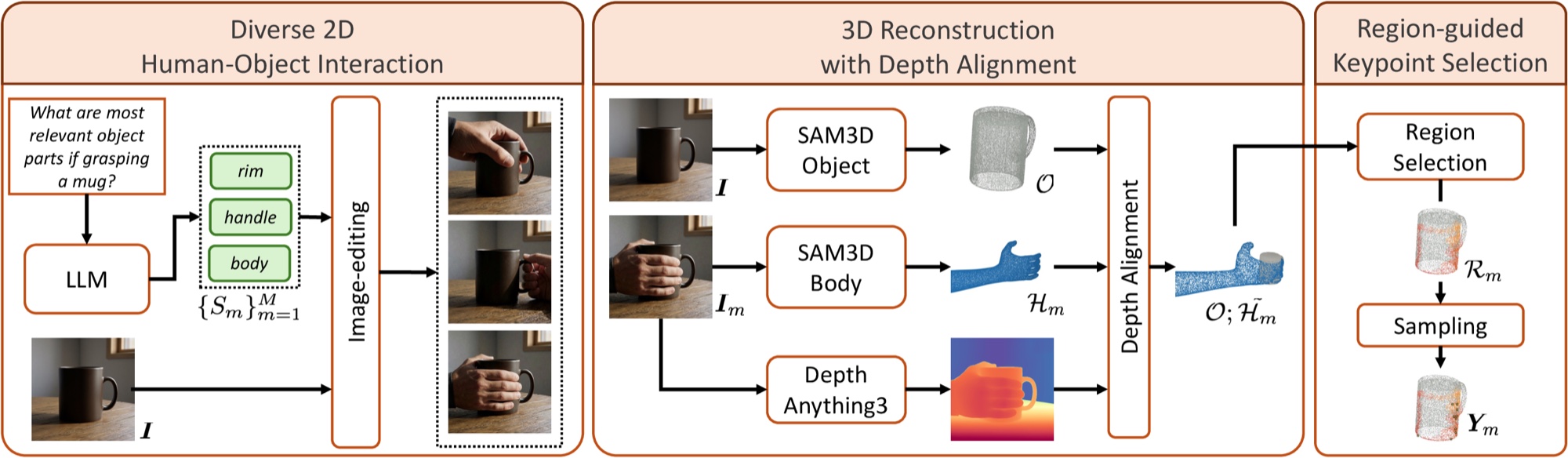
To scale multi-mask 3D affordance annotation, we build an automated pipeline on top of 2D generative models and 3D reconstruction. Given an object image, an LLM proposes plausible interaction subparts (e.g., “rim”, “handle”, and “body” for grasping a mug), and an image-editing model synthesizes a human-object interaction image for each subpart. We then reconstruct the 3D object and human/hand with depth alignment, extract contact keypoints, and propagate them into soft 3D affordance labels. Human annotators only inspect and filter the results (about five seconds per sample), a 72× reduction in annotation time compared with manual point-level labeling.
Quantitative Results
Diverse 3D affordance grounding
| Method | GED-AUC↓ | GED-MAE↓ | GED-SIM↓ |
|---|---|---|---|
| 3D-ADLLM* | 0.731 | 1.712 | 0.973 |
| GEAL | 0.418 | 0.391 | 0.782 |
| PointRefer | 0.337 | 0.169 | 0.745 |
| PointRefer-LDM | 0.371 | 0.120 | 0.636 |
| PointRefer-CVAE | 0.415 | 0.096 | 0.602 |
| Div3DAffordNet (Ours) | 0.254 | 0.096 | 0.492 |
Single-mask 3D affordance grounding
| Method | AUC↑ | MAE↓ | mIoU↑ | SIM↑ |
|---|---|---|---|---|
| 3D-ADLLM* | 0.500 | 0.388 | 3.6 | 0.399 |
| GEAL | 0.824 | 0.132 | 18.2 | 0.567 |
| PointRefer | 0.858 | 0.096 | 18.8 | 0.617 |
| Div3DAffordNet (Ours) | 0.842 | 0.093 | 19.0 | 0.623 |
* Direct inference with the official checkpoint.
Qualitative Results
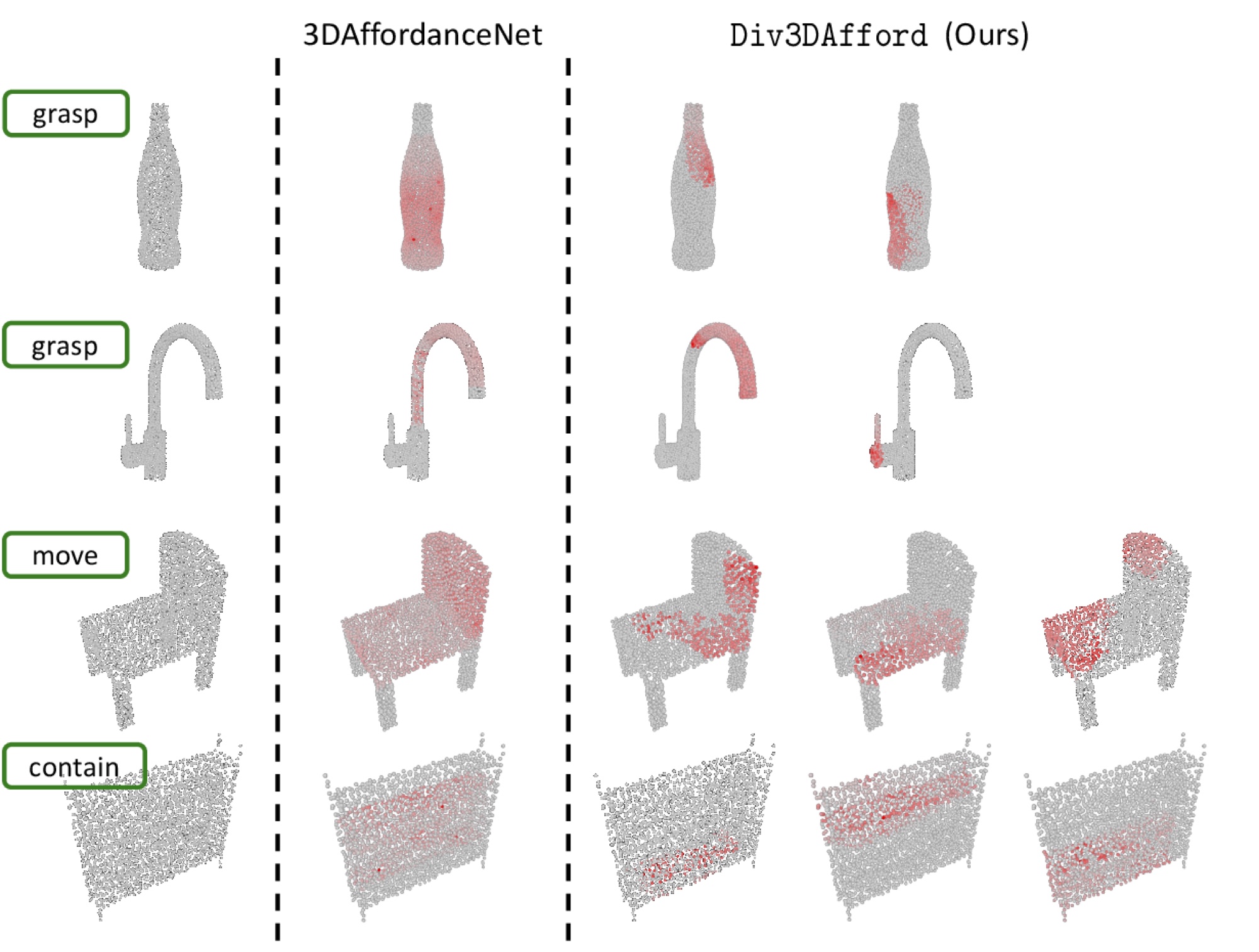
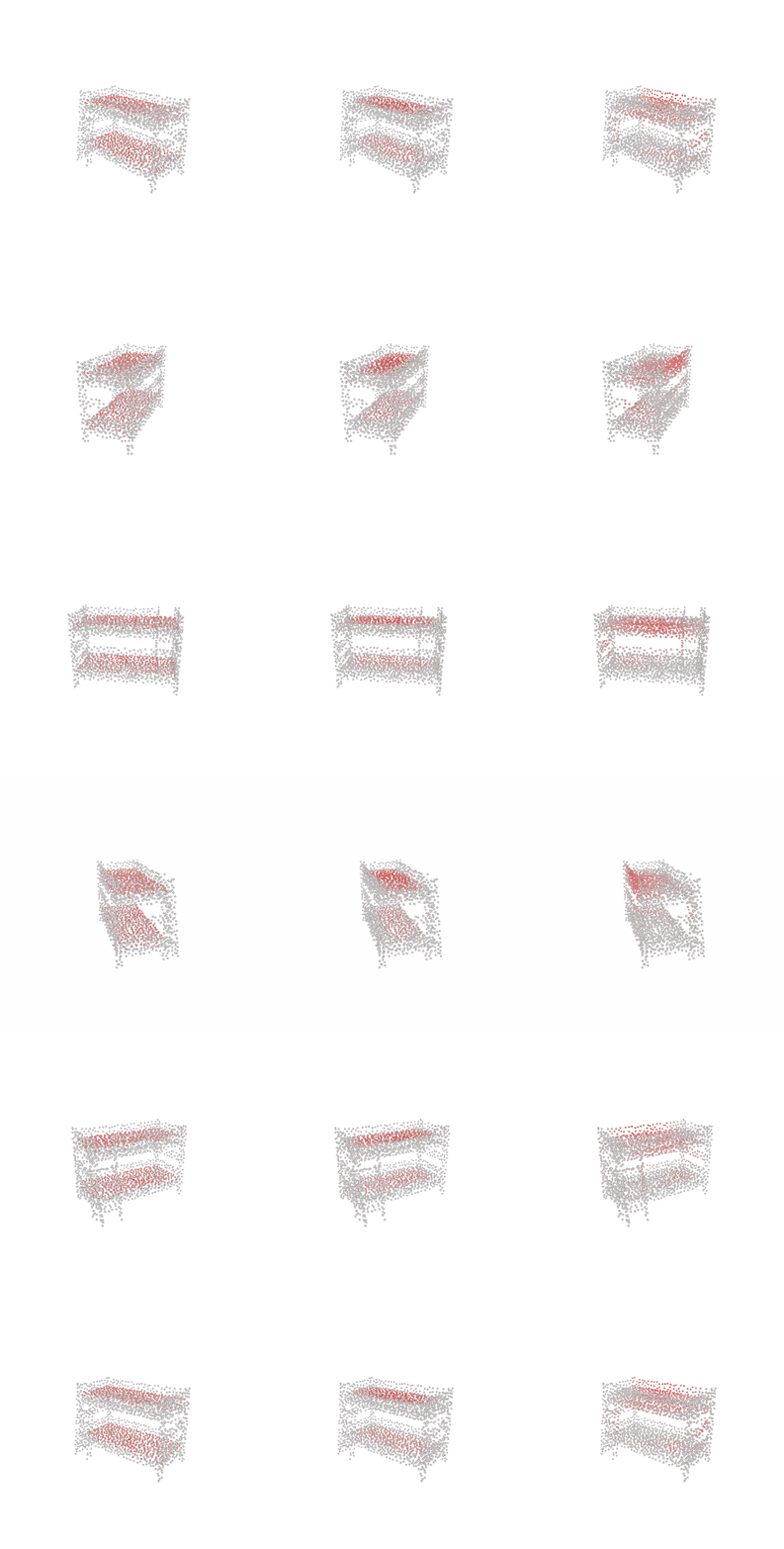
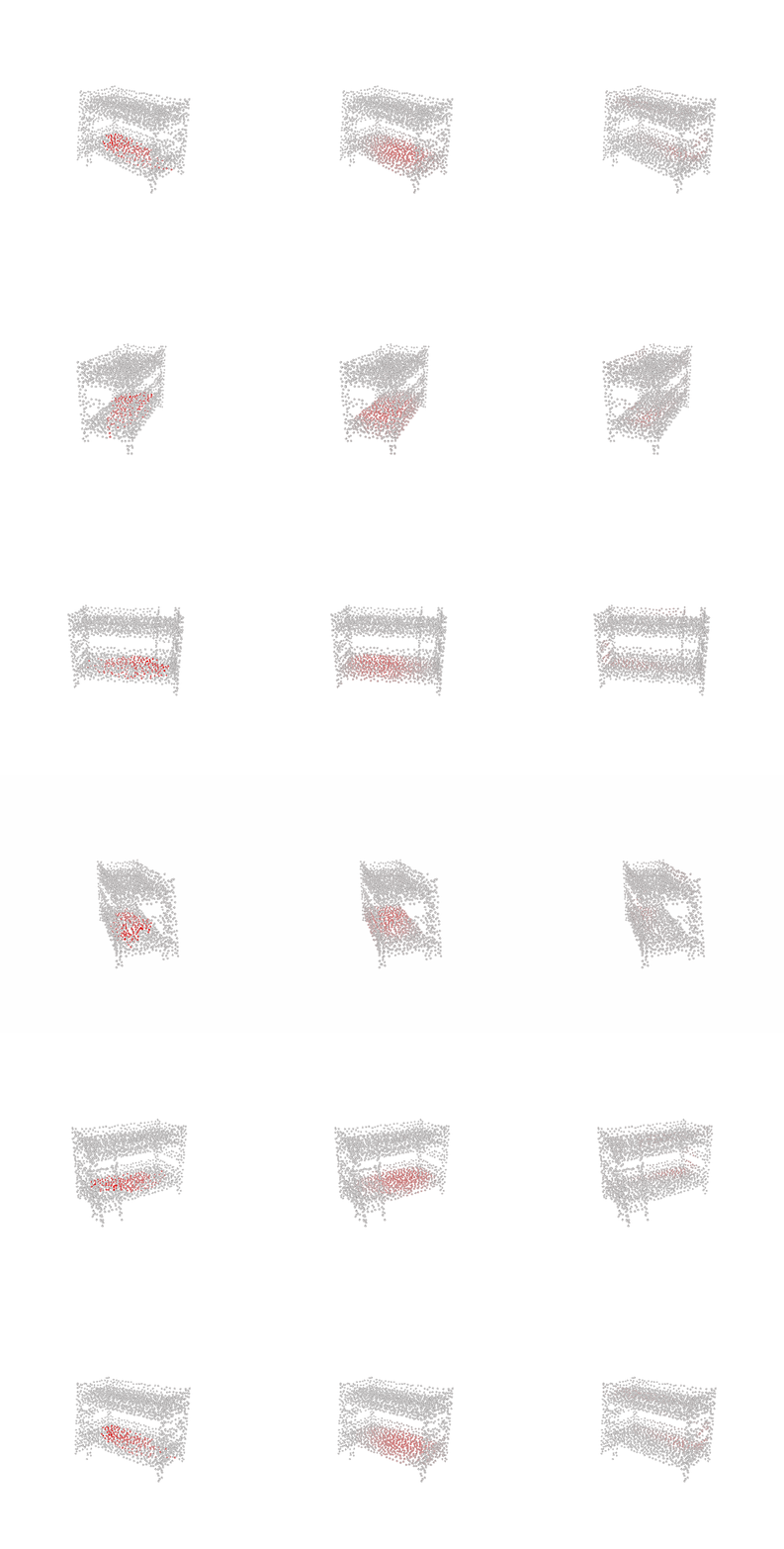
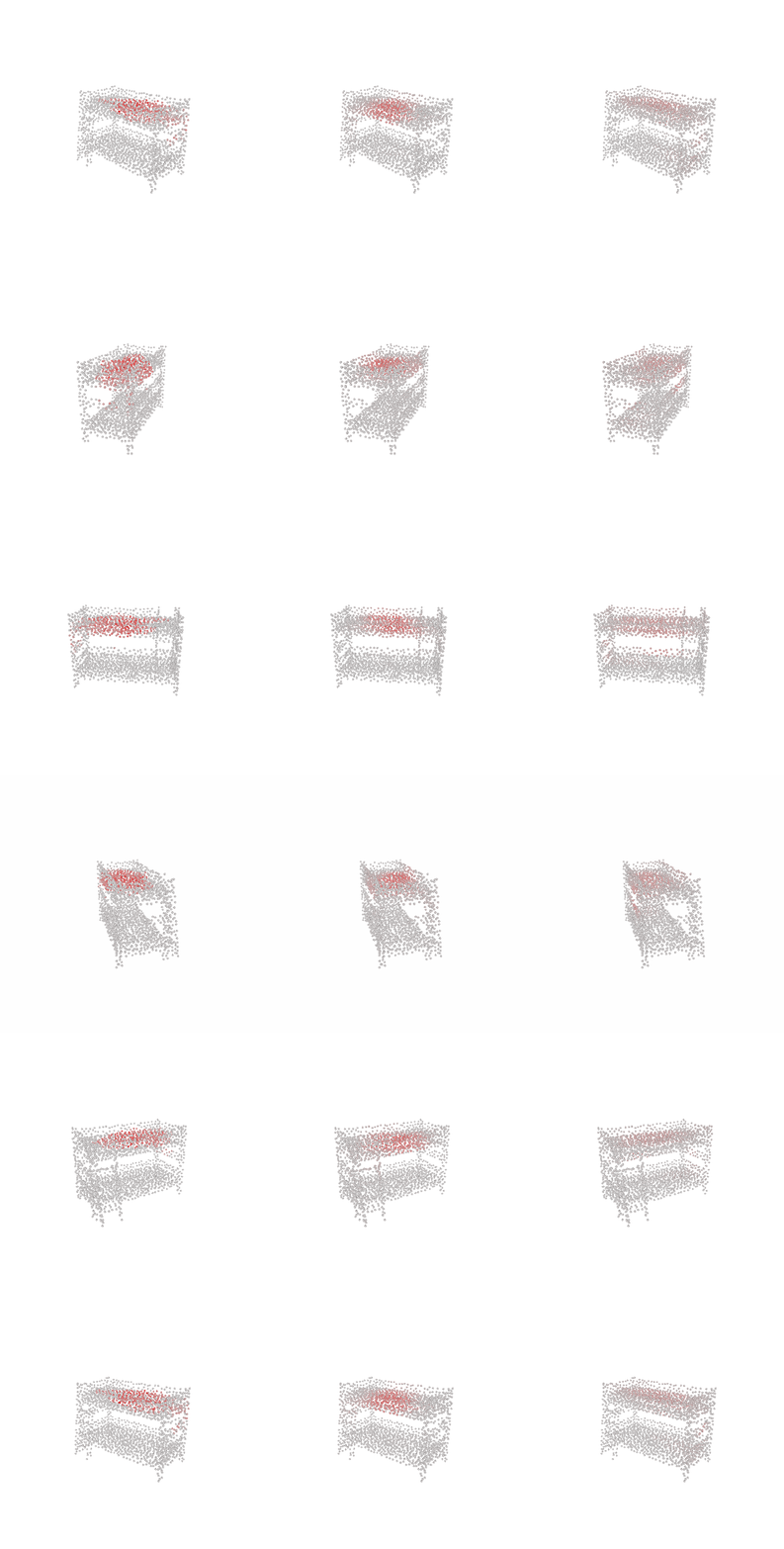
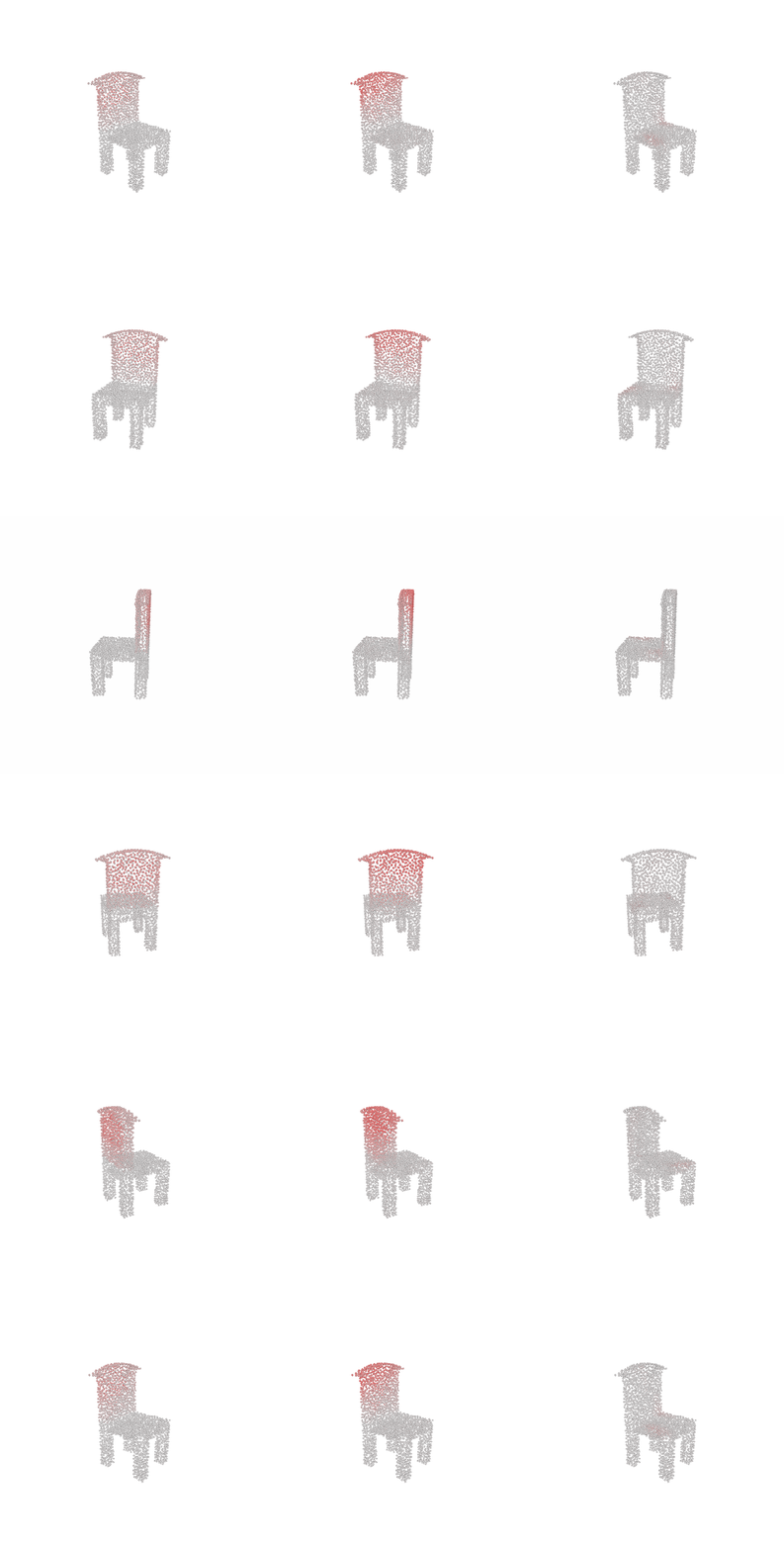
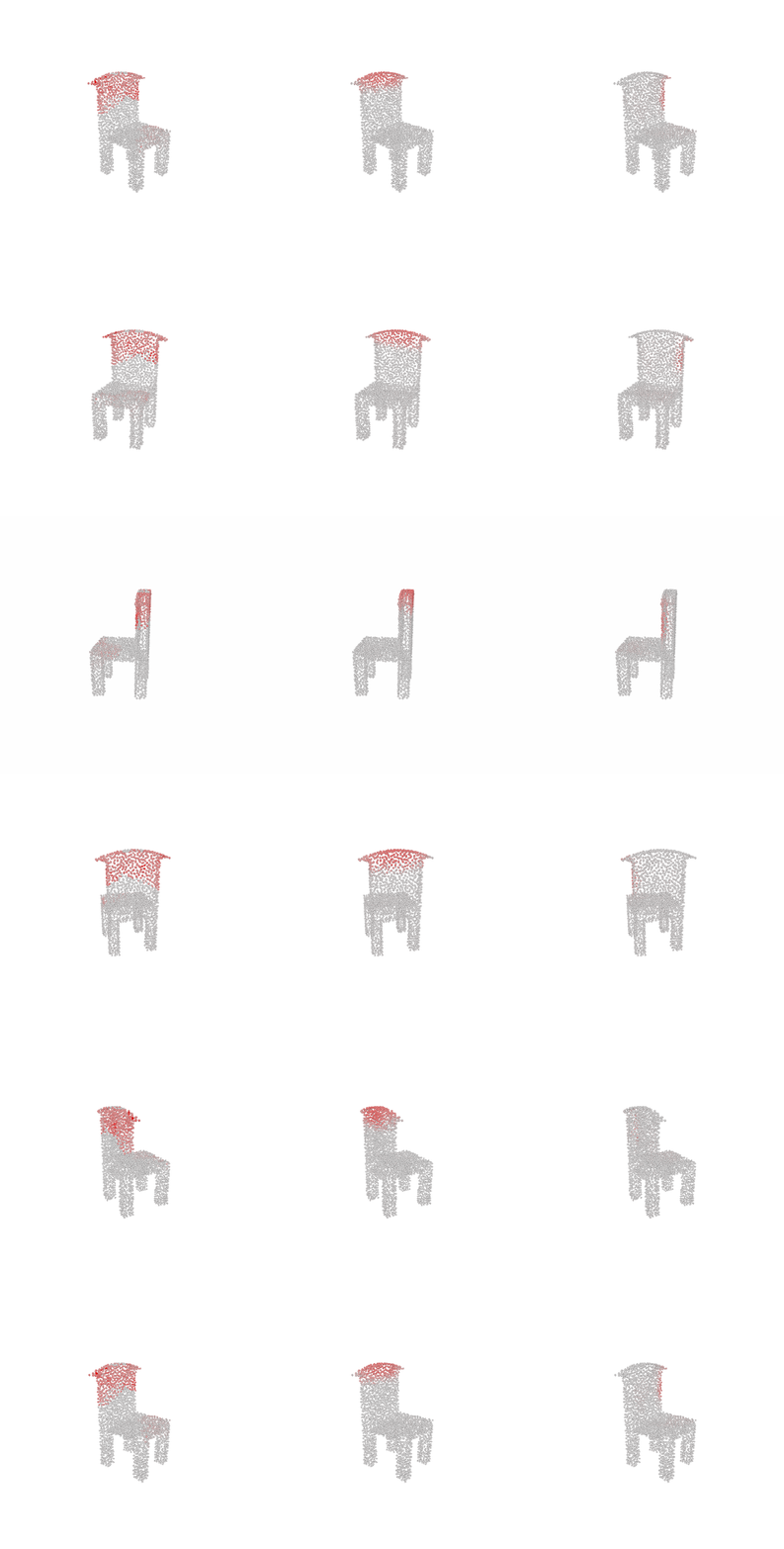
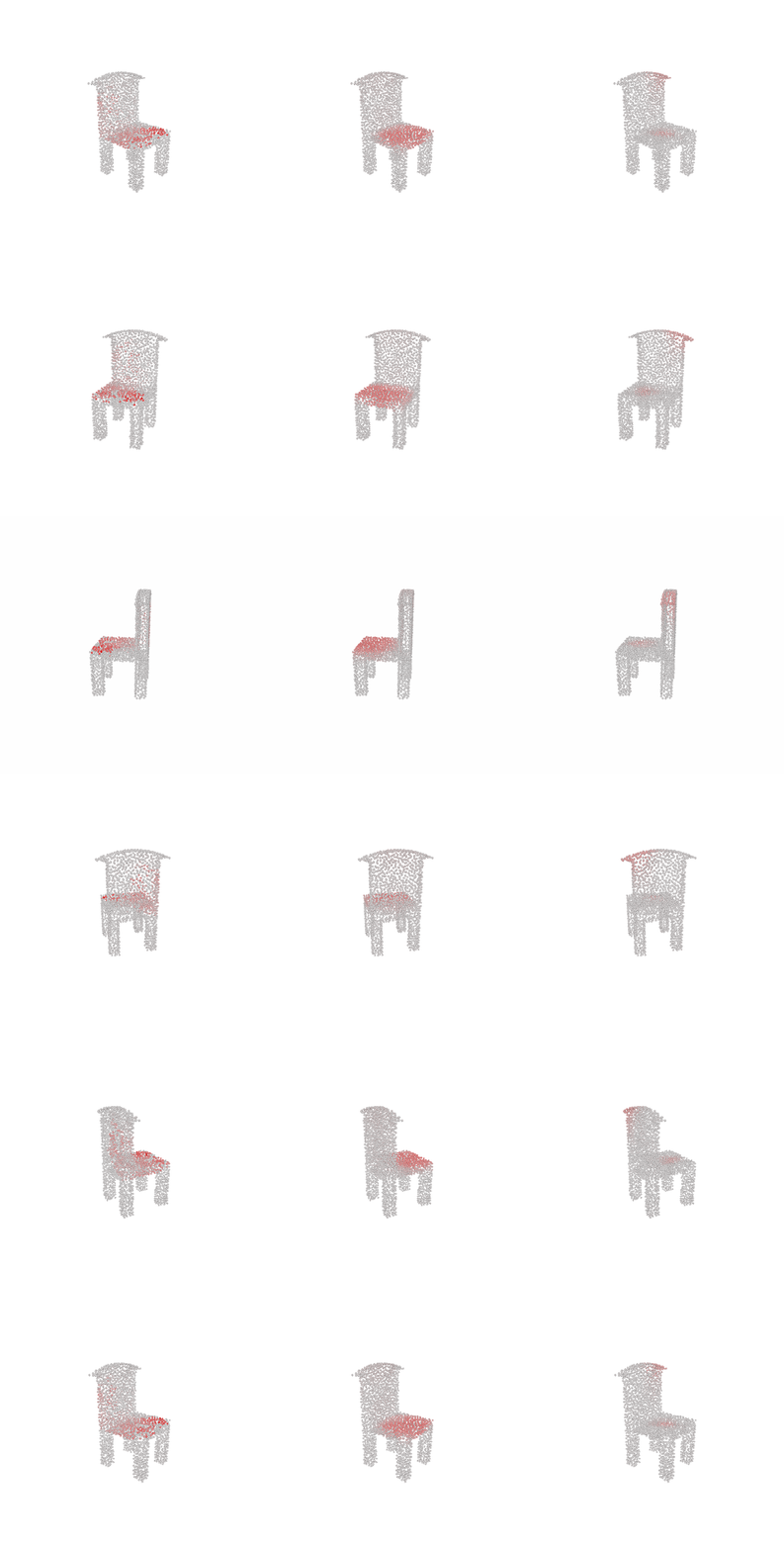
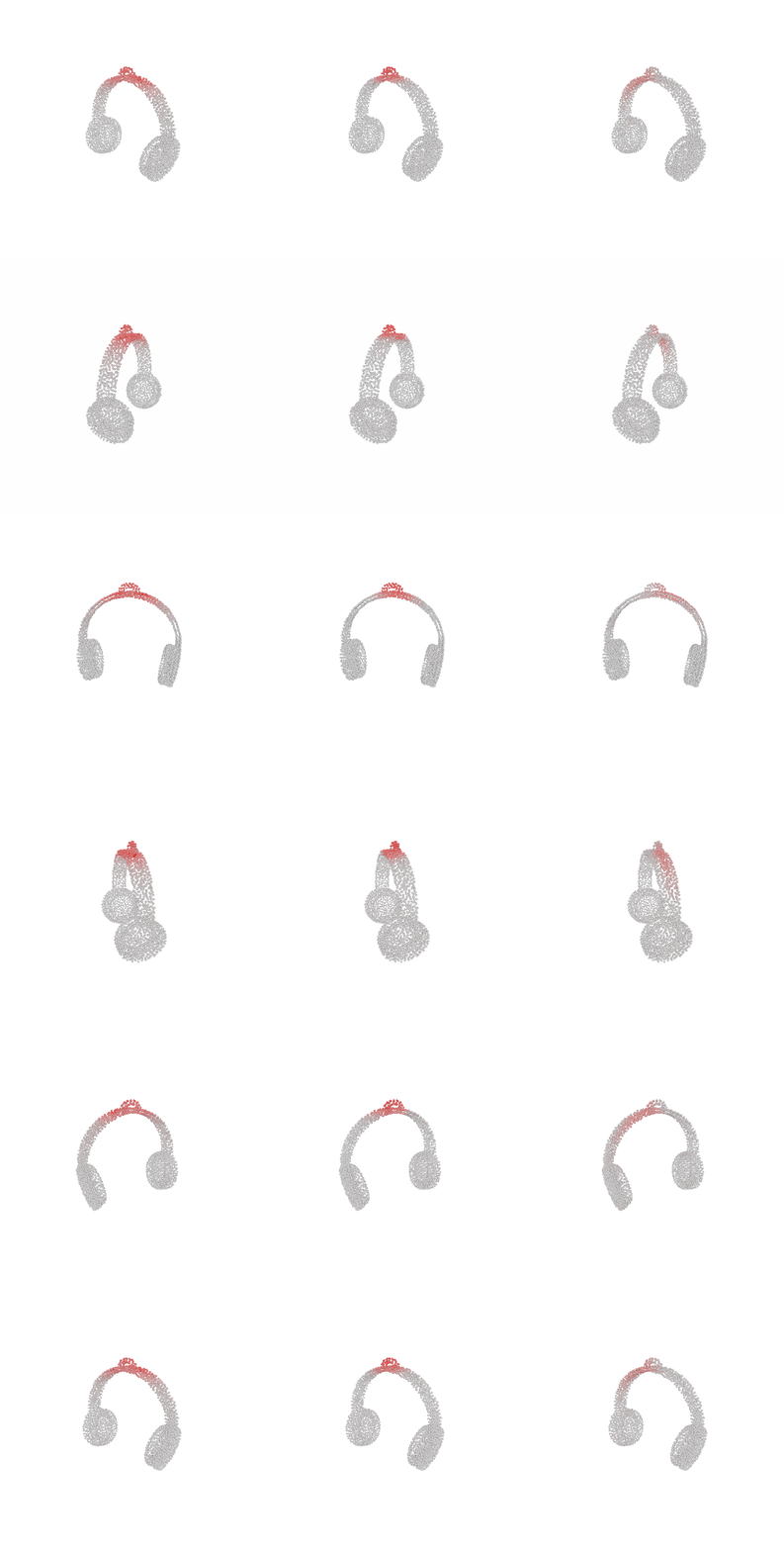
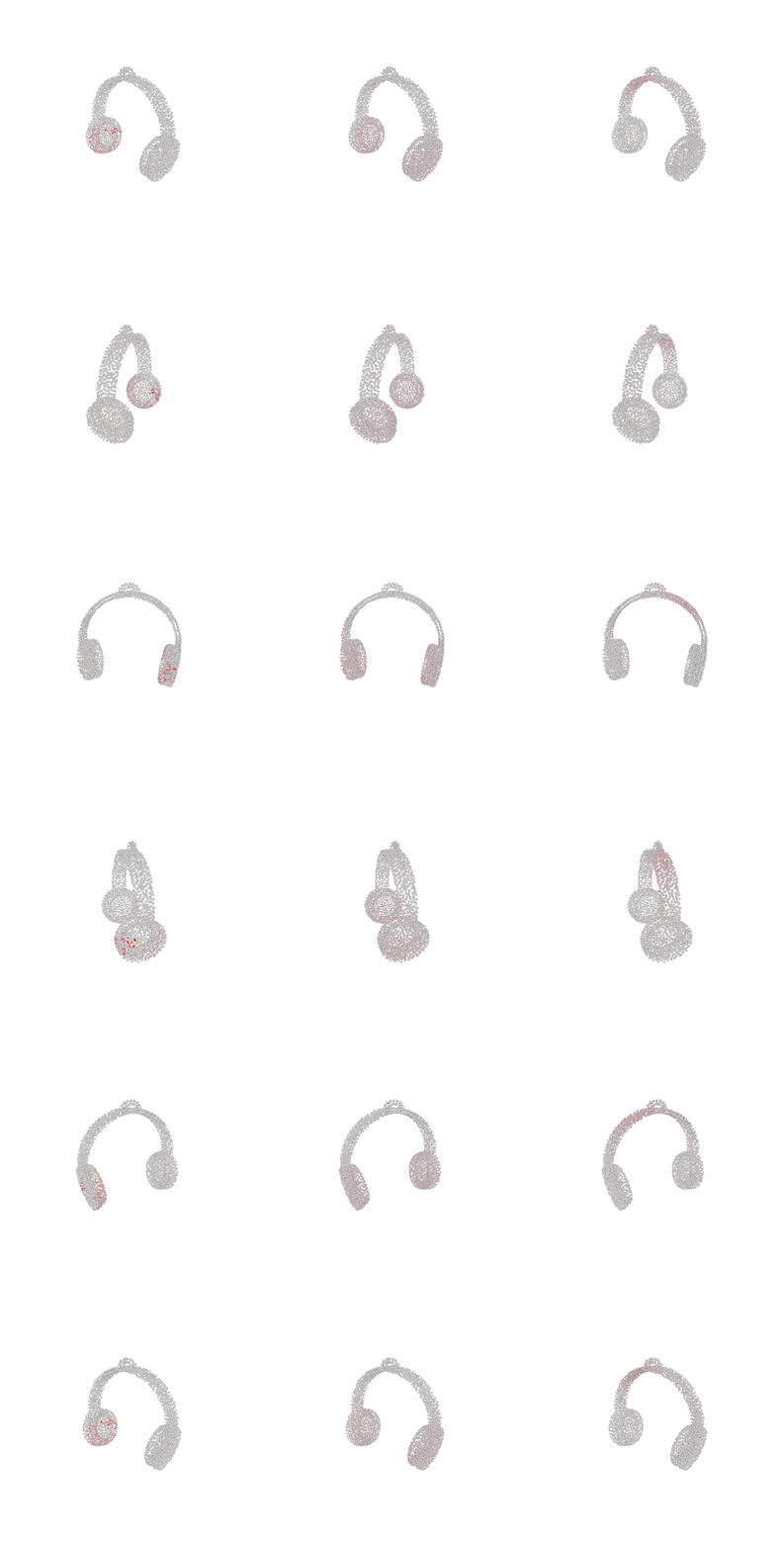
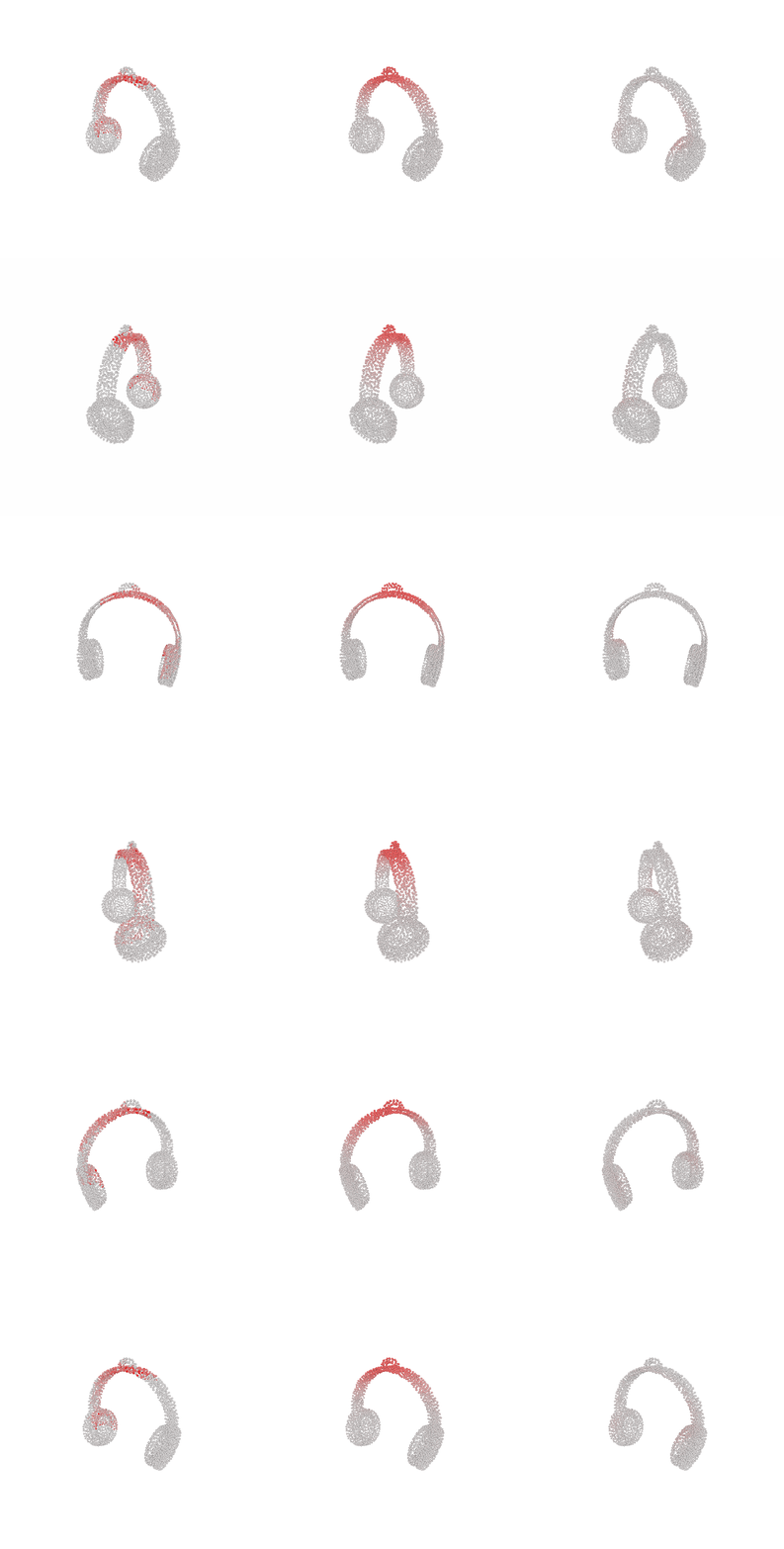
Comparison with the PointRefer-CVAE baseline on the Div3DAfford validation set. For each object-affordance query, each row shows one method and each column shows one affordance mode. Red indicates the affordance region.
Bed – layable
Chair – move
Earphone – grasp
Citation
@article{zhang2026div3dafford,
    title   = {Div3DAfford: Diverse 3D Affordance Grounding},
    author  = {Haomeng Zhang and Raymond A. Yeh},
    journal = {arXiv preprint},
    year    = {2026}
}