Zero-shot 2D Grounding with Novel Affordance Types
Purdue University
Abstract
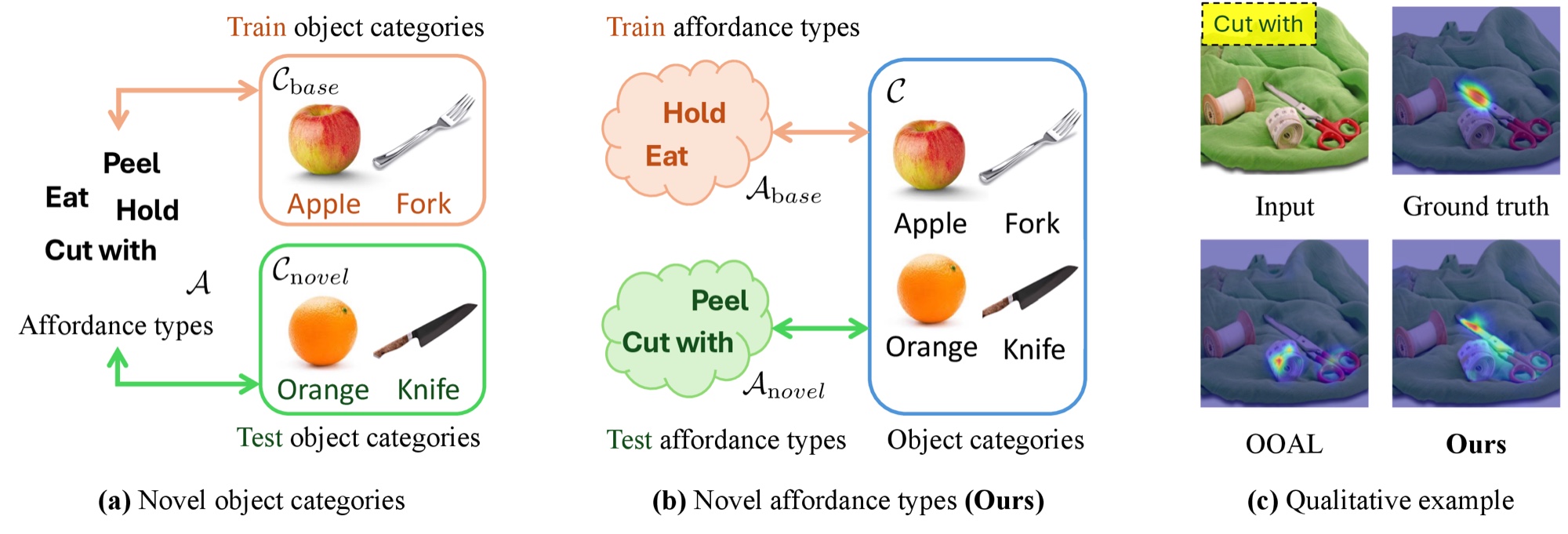
2D affordance grounding aims to locate the region of an object that a human can interact with. Existing research focuses on recognizing affordance types seen during training and does not study models' ability to generalize to novel affordances, which is crucial for real-world applications. We propose the task of zero-shot 2D grounding with novel affordance types (NAT) and introduce the NAT benchmarks. We then propose AffordAnything, a training-free method that leverages segmentation cues, motivated by the strong correlation between affordance regions and object subparts. To further improve performance, we develop AffordAnything+, a trainable variant that learns to combine these cues. On the proposed AGD20K-NAT benchmark, our best model AffordAnything+ achieves a substantial improvement of 12.3% (absolute) in IoU@0.4 over the SOTA affordance grounding method, OOAL.
AffordAnything: Training-free Affordance Grounding
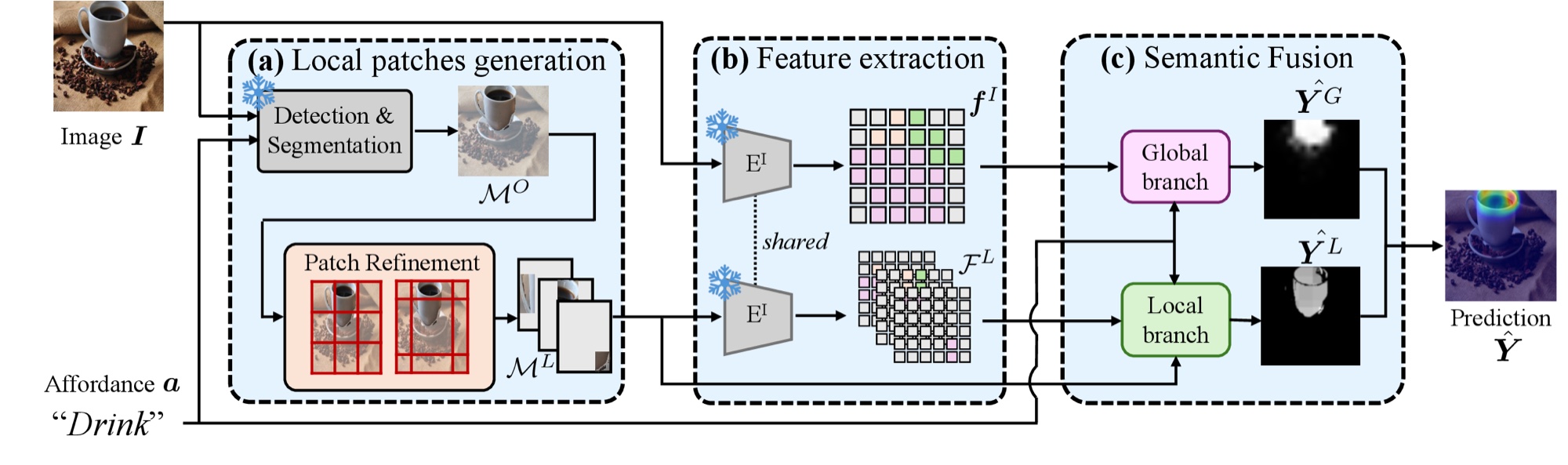
Affordance regions strongly correlate with specific sub-parts of an object. AffordAnything first generates local patch candidates through (a) an open-vocabulary detection-and-segmentation backbone and a patch refinement module that decomposes each object mask into evenly-focused and border-focused patches. Next, (b) image-, patch-, and text-level features are extracted with a frozen CLIP, and (c) fused in a multi-branch semantic fusion module that combines a global branch prediction with a local branch prediction weighted by patch-text similarity.
AffordAnything+: Trainable Fusion
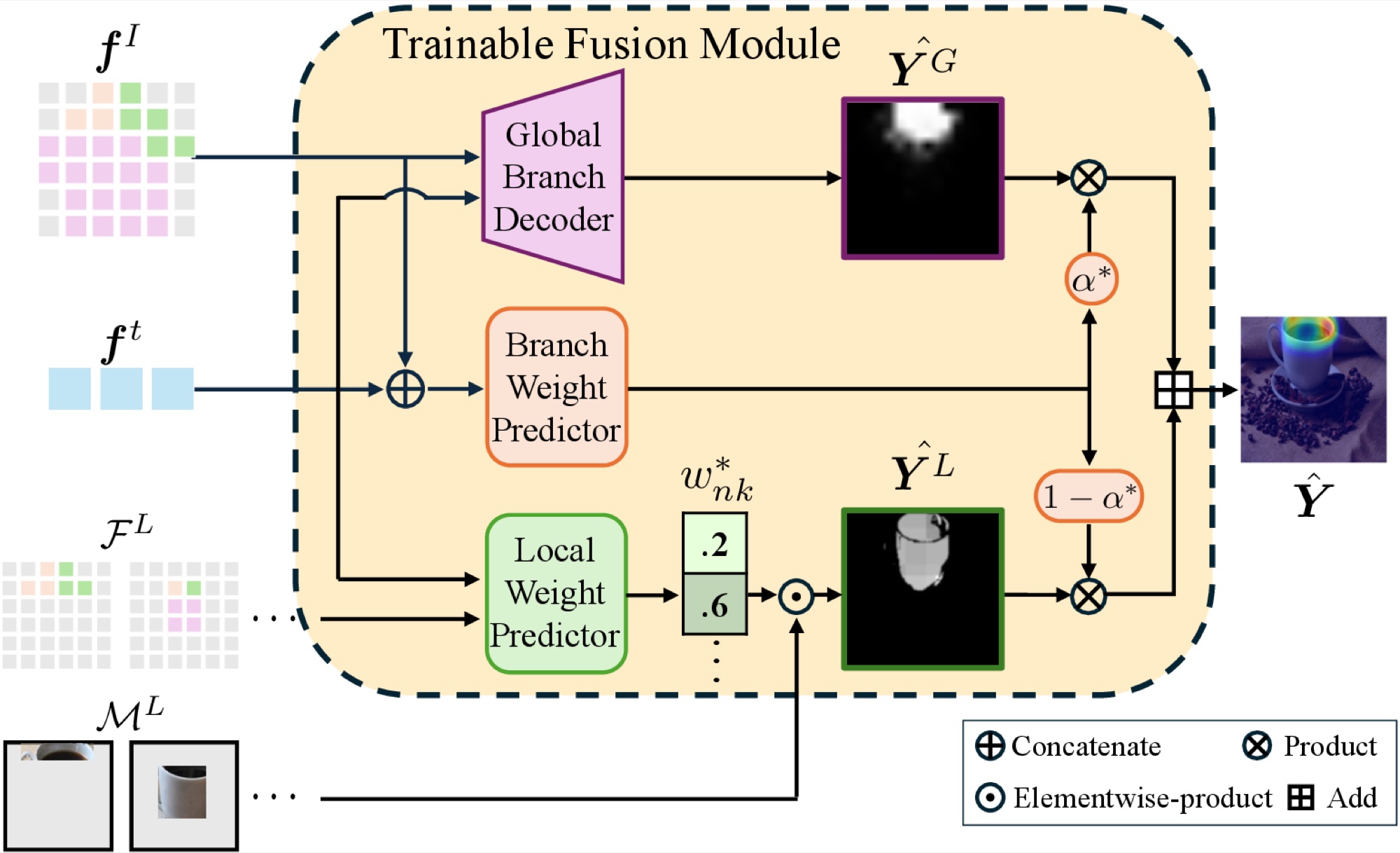
AffordAnything+ integrates a lightweight trainable fusion module consisting of (i) a branch weight predictor, (ii) a global branch decoder, and (iii) a local weight predictor. The global branch prediction $\hat{\mathbf{Y}}^G$ and local branch prediction $\hat{\mathbf{Y}}^L$ are weighted by the learned branch weight $\alpha^*$. By only learning the fusion weights, the model preserves the training-free, affordance-independent local segmentation cues and reduces overfitting to the training samples.
Quantitative Results
Training-free setting
| Method | AGD20K-NAT IoU↑ | UMD-NAT IoU↑ |
|---|---|---|
| SCLIP | 4.2 | 2.0 |
| ClearCLIP | 4.4 | 0.5 |
| ProxyCLIP | 6.4 | 4.0 |
| GEM | 8.2 | 0.9 |
| AffordAnything (Ours) | 21.3 | 27.9 |
One-shot training setting
| Method | AGD20K-NAT | UMD-NAT | |||
|---|---|---|---|---|---|
| KLD↓ | SIM↑ | NSS↑ | IoU↑ | IoU↑ | |
| SCLIP | 2.057 | 0.215 | 0.189 | 9.3 | 5.5 |
| ClearCLIP | 1.722 | 0.269 | 0.803 | 13.6 | 8.8 |
| ProxyCLIP | 1.925 | 0.245 | 0.459 | 13.7 | 6.9 |
| GEM | 1.860 | 0.247 | 0.516 | 11.6 | 26.9 |
| OOAL | 1.617 | 0.323 | 0.803 | 10.6 | 18.3 |
| AffordAnything+ (Ours) | 1.374 | 0.368 | 1.053 | 22.9 | 30.3 |
IoU is reported at threshold 0.4.
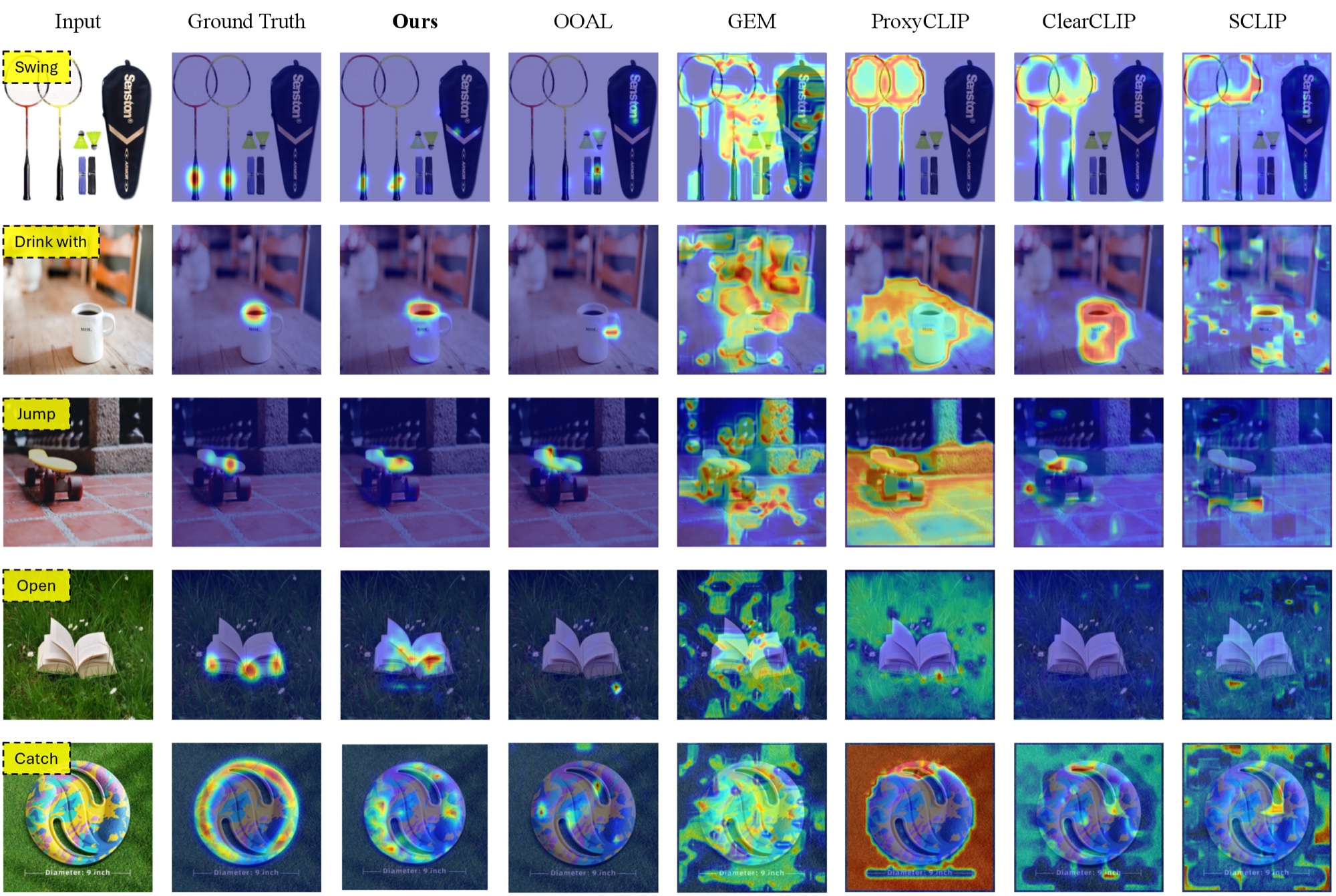
Qualitative Results

Citation
@article{zhang2026nat,
    title   = {Zero-shot 2D Grounding with Novel Affordance Types},
    author  = {Haomeng Zhang and Raymond A. Yeh},
    journal = {arXiv preprint arXiv:2608.08929},
    year    = {2026}
}